One of the themes of the course I teach on “War and Holocaust” is the importance of interrogating the nationalist myths which still circulate in the historical discourse.
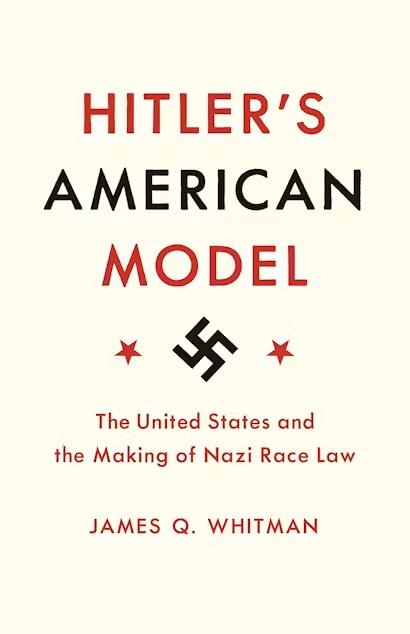
In a recent class session, we discussed James Whitman’s book, Hitler’s American Model: The United States and the Making of Nazi Race Law (Princeton UP, 2017). Whitman teaches comparative and foreign law at Yale, and more Americans should read his book to understand the history of Nazism, as well as the history of the United States.
In 1934, at a meeting of Nazi lawyers who were tasked with translating Hitler’s racial ideology into law, there was a long and probing discussion of American law and customs. The most virulent racists at this meeting were the most vocal champions of the American model. The meeting took place during America’s “Jim Crow” era (legal segregation), when lynchings and other acts of racial terror unfolded with appalling frequency.
The thesis of Whitman’s books flows from the records of the lawyers’ meeting in 1934 (and others like it), where Nazi intellectuals sought to codify the Party’s racial ideology and turn it into policy. This was a crucial step in the crescendo of violence that culminated in the Holocaust. Before they could become the targets of genocidal violence, Jews had to be destroyed legally and socially. Hannah Arendt would analyze this process in The Origins of Totalitarianism (1951).
But back to the lawyers’ meeting in 1934…
Whitman argues that Germany’s Nuremberg Laws (on citizenship and blood purity) drew from and were modeled upon American race laws of the 1930s. Citing the Jim Crow laws in the U.S. south, one of the most vicious Nazi lawyers, Roland Freisler, said:
“This jurisprudence would suit us perfectly, with a single exception…the Jews are not reckoned among the coloreds.”
Although Nazi Germany would end up declaring war on America, in the 1930s, the Americans were still a source of inspiration and grudging admiration. In Mein Kampf, the memoir he wrote in prison following the failed Beer Hall Putsch (1923), Hitler cited the U.S. approvingly as the only major power to have made real “progress” on the question of race.
Nazi eugenics also drew heavily on the work of American theorists, including George Cutten, who served as the president of my current institution from 1922-42. Cutten, whose anti-immigration rhetoric is cited at the Immigration Museum on Ellis Island, delivered a speech in 1922 in which he said that Americans had made the word democracy into a fetish. “The rule [in government],” Cutten argued, “must be aristocracy.”
Cutten later derided social security as a “degrading” handout which went to support “parasitic paupers.” He condemned modern medicine and philanthropy for propping up individuals who, as he saw it, were meant to fall out of the gene pool. Bemoaning America’s cultural pluralism and ethnic/racial diversity, Cutten once said, “what [America’s] melting pot has accomplished is to permit persons of different races and intellectuality to marry and deteriorate our stock at an alarming rate.”
You can see in Cutten’s appraisal how Germany’s NSDAP, steeped in eugenics theory and eager to find a solution to what would be called, euphemistically, “the Jewish question,” might look to America as a potential framework for emulation.
In Whitman’s words:
“The proposition that the Nazis drew inspiration from American race law in creating their own program of racial persecution is sure to seem distressing…But in the end it should really come as no great surprise to attentive readers of…history.”
While we were discussing Whitman’s book, one student asked whether Hitler had ever considered seeking an alliance with the United States, given the links and affinities between German and American law.
That never happened. By the time the Nazis were getting political traction in Germany, Hitler had come to see the U.S. as an imperialist threat and a potential rival in his bid for hegemonic power. But that doesn’t mean he didn’t also admire certain aspects of American law and history.
In the American concept of “Manifest Destiny” and in the westward expansion of the United States, Hitler saw a precedent for his own program of expansion and imperial conquest. What Manifest Destiny was to the U.S. Hitler’s thirst for Lebensraum (“living space”) was to Nazi Germany. Both represented the intertwining of territorial ambitions and violent racial fantasies.
But this isn’t only a lesson for the history books. Whitman’s scholarship also tells a great deal about the present.
When Donald Trump threatens to send a naturalized citizen like Rep. Ilhan Omar “back to Somalia” and when he asserts his authority to end birthright citizenship, he is seeking to take America back to the “blood purity” laws of yesteryear. This is the same program that the Nazis drew upon when they were formulating the Nuremberg laws. By purging/negating one group of citizens, Trump reinscribes the citizenship and asserts the supremacy of those who remain. You can find this program described by Umberto Eco on his list of the cardinal characteristics of Eternal Fascism (see no. 13).
Under Eternal Fascism:
“Individuals as individuals have no rights, and the People is conceived as a quality, a monolithic entity expressing the Common Will. Since no large quantity of human beings can have a common will, the Leader pretends to be their interpreter. Having lost their power of delegation, citizens do not act; they are only called on to play the role of the People.”
When I ask my students whether they know the history of so-called anti-miscegenation laws in the U.S., not many know what I’m referring to. These were the laws that aimed to protect the purity of the “white race” by prohibiting interracial marriage.
Quick fact: Alabama was the last state to repeal its legal prohibition on interracial marriage. This happened in 2000, more than 30 years after such laws had been struck down by SCOTUS as unconstitutional.
When MAGA invokes states’ rights today, it’s at least partly informed by a nostalgia for legal segregation and the project of blood purity that segregation directly supported.
In July 2026, birthright citizenship, guaranteed in plain language in the 14th Amendment to the U.S. Constitution, was
upheld by the Roberts Court in 6-3 vote.
That three Justices (Alito, Thomas, and Gorsuch) found grounds for supporting Trump tells us not only that the Court has been massively corrupted by illiberal ideology, but also that the “Constitutional originalists” have never been serious or principled people, but only politicians masquerading as jurists.
All of this would be shocking, if it weren’t for the lessons which history offers. The thread that runs from Jim Crow to Nuremberg to Trump 2.0 is not hard to find for those who endeavor to live in truth.
Within the MAGA clique, explorations of the past like the one here are deemed unpatriotic. Individuals who engage history through a critical lens are accused of hating their country.
But I don’t hate America, and I’m not out to destroy what right-wingers sometimes call “western civilization,” even if these stains on American democracy are a source of profound shame for me.
Do I hate my country?
No.
I wish for it to be honest and to love the truth enough to face its many problems and broken promises.


Leave a Reply